
The Bittersweet Irony of Thanksgiving
The bittersweet irony of Thanksgiving is once again upon our family. Four members of my immediate family have died in November, two of my sisters, Jean and Donna, died on Thanksgiving Day, another sister, Evie, and my dad died a few days before Thanksgiving.
This, in a season when we give thanks for all our blessings and begin the rush to Christmas joy. Instead of being full of thanks, at times my heart has instead resembled the crusted leftovers at the bottom of the dressing pan.
If ever a person needs favor and grace, it’s when life has delivered you to the dark precipice and pushed you into the valley below.
I know a lot about being thankful, learning the phrase “Praise the Lord anyway!” early in my Christian walk. It was easy then, when the world seemed fresh and alive and new. But during times of deep grief, when I passed through the valley of death, my praise well was empty. Indeed, I didn’t walk through the valley in my own power, but seemed to be carried by the pallbearers of my grieving spirit.
The death of loved ones is never easy, but the gaping hole left in holidays you once shared is particularly hard to fill, especially when the deaths cluster together. A pall hung over me as the years passed. Every Thanksgiving I frantically tried to cover the hole left by absent family members. It wasn’t until many years later that I was set free from the oppressive grief and was able to enjoy Thanksgiving again.

High school photos of Jean, Donna and Evie
Most of those deaths happened many years ago. Then in 2012, as I put the turkey in the oven about dawn on Thanksgiving morning, the phone rang. My oldest sister, Jean, had died a few minutes earlier. Would I sink under the grief again? While her death was not unexpected, it was Thanksgiving. One more Thanksgiving, one more death in the family.
I’m happy to report that year I did not fall into a pit of grief and despair again. The pallbearers of my spirit did their job and carried me through the valley.
Many people experience grief during the holidays. Every year they, and maybe you, face the holidays with a splintered family.
It has now been three decades since the Thanksgiving death pall began in our family. One of the benefits of getting older is you have the perspective of time. For those of you who are grieving during the holidays, here are a few thoughts to hang onto. While they can’t fix what happened, perhaps you will find comfort in them.
- Use this holiday season to count your blessings.
- Tell someone your story. People say they want to help, well, here is a way they can, by listening. Tell you first memory, best memory, worst memory, last memory and everything in between. At a funeral, sometimes tears give way to stories that make you smile. Find those smiley stories.
- Write down your memories. This is a great healer, the third best way to deal with grief.
- Helping others. It will release endorphins into your system and help you find peace. Volunteer to serve a holiday meal at a homeless shelter. Ring the bell for the Salvation Army. One person I know chooses to work on holidays so others can be with their families.
- Finally, ask the Lord Jesus to heal your broken heart and to give you a future and a hope. You may not feel like you want to go on, but you are alive and that means you still have a purpose to fulfill here on earth.Isaiah 53: 4 states, “Surely he has borne our griefs and carried our sorrows.”
- That isn’t just a vague promise, but a powerful one. He can and will carry you through the valley of grief and bring you out the other side if you ask him.
- One definition of pall is “the white cloth given in baptism and the resurrection of Christ at Easter.” So “pall-bearer” signifies the one who bears a coffin covered by hope of the resurrection. You see, grief has always been associated with grace. It is only through the death and resurrection of Christ that we can have hope for eternal life and hope of seeing our loved ones again.
The Psalms Speak to our Hearts
 This year, I am reminded of how relevant the Psalms are for life today. They keep cropping up in my devotional. At church, Pastor Dan presented a series called “Summer in the Psalms.” Then last week I received notice that “Psalms Alive” is the theme set for the upcoming Java Joy gatherings.
Although I first became familiar with the Psalms when I was a young girl, I still learned a couple things from the sermon series and also from a peek at the Java Joy website.
When I was growing up, we lived a mile down the road from Cottonwood Church. From our place, it looked like a white dot on the wheat-covered prairie. Although the church closed many years ago, it has continued to inspire me in writing “By the Banks of Cottonwood Creek” and also the historical novel I hope to publish soon.
The church had two main rooms. Church services were held in the green room, while the primary Sunday school class met in the pink room, which also held supplies and an oil burning stove. The women managed to function in a minute-sized kitchen with no running water. A hole in the ground beneath the building was majestically called the basement.
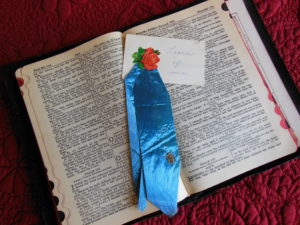
Sunday school was a highlight of my week. The family Bible still holds a bookmark that I made for my mother back then. One time we made a dough of salt and flour and fashioned objects from the time of Christ, such as an oil lamp and a bowl. Those objects were put in the bookcase in the pink room and were still there years later. One steamy summer Sunday, we trooped down the outside steps to the basement and tried to hold class there. That ended quickly when we found some lizards.
Perhaps my single best experience at Cottonwood Church took place when I was nine. I was very surprised to be called to the front of the church during the morning service and presented a black Bible with my name printed on the front in gold; I was graduating to the class that met in the green room!
It was only as an adult that God’s message became real to me.
It was in Sunday school that I learned my way around the Bible. We memorized the books in order and had a new memory verse every week. I still remember, open it in the middle and you are in Psalm 119, and the New Testament begins three quarters of the way through.
Still, it was only as an adult, when I began searching for the meaning of life, that God’s message became real to me. Even so, I couldn’t particularly relate to the Psalms. Only after I’d been matured by the birth of children, the death of loved ones, and the struggles of life did the Psalms begin speaking to my heart. These 150 songs now console and encourage me. The promises are as trustworthy today as they were when they were written.
These 150 songs now console and encourage me.
When I read through Psalms every year, I always find a wonder. Sometimes it’s a special verse, such as when I began my career in a statewide organization, I underlined Psalm 18: 19: “He also brought me out into a broad place; He delivered me because He delighted in me.” Note to readers: He delights in you, also!
Some psalms have been set to today’s music. Reading the words may remind me of a song that will then play in my head for the rest of the day. One of those is Psalm 27: 14: “Wait on the Lord, be of good courage, and He shall strengthen your heart; Wait, I say, on the Lord!” That message of waiting isn’t one I always want to receive, but it is wisdom to the core.
Sometimes I come upon a verse that I’ve read many times, but it suddenly makes my heart leap as I see it in a new light. “They shall still bear fruit in old age; They shall be fresh and flourishing.” That’s Psalm 92: 14 and it’s a promise that I rest in as I sit at the computer every day.
Have you considered reading through the Psalms? Try reading one Psalm a day using a modern language edition, such as the New International Version or the New King James or The Message. To take a peek at the “Summer in the Psalms” series by Pastor Dan, go to www.cccc.bismarck.com and look under Messages. Get further inspired at the Java Joy and Joy International website at www.joyintl.org.
The August Life of Retirement

Mount Evans, Colorado, has a majestic view!
August: Marked by majestic dignity or grandeur.
With the August heat baking on and the political season bumping along, I don’t have the will to write about anything serious, like the plight of vegetables in an increasingly vegan world or why the rabbit picked on our garden this summer.
But, I’m two years retired now and I would like to discuss the discrepancy between my retirement dreams and today’s realities. So here it goes:
Dream 1: Every day I’ll sit on the front porch in the sunshine and drink my morning coffee. I had this fantasy on summer days for 28 years as I backed out of the garage and went to work in chilly offices.
Reality 1: A swarm of yellow jackets is living under the front step this summer. They own the porch and they don’t want anyone parking there with a cup of coffee.
Dream 2: I’ll keep in touch with my work friends. We’ll have plenty of time to shop and do lunch.
Reality 2: Let’s see, maybe I can work lunch in a week from Tuesday, after my dental appointment and before…oh, you’ll be out of town for three weeks? And I’m surprised by new friends and interests at this intersection of life.
Dream 3: There’s no reason I can’t write a book a year and supplement my income.
Reality 3: People who write a book a year must have an in-house computer guru; a marketing firm; and no arthritis in their hands.
Dream 4: I’ll have plenty of free time and energy.
Reality 4: A dollar, please, for every time I go looking for my glasses or answer the phone to find it’s a robo call.
Dream 5: I’ll exercise every day and bake bread every week.
Reality 5: The people at my exercise place are always surprised to see me. My husband shops for bread every week.
Dream 6: I like dressing up and will continue to do so.
Reality 6: I can’t believe I used to wear pantyhose. Every day.
Dream 7: We’ll travel a lot.
Reality 7: We just got back from a wonderful trip to Colorado and California. It takes a lot planning and follow-up. Maybe one trip a year is enough.
So, I polled a few retired friends to see what they think. Do their retirement dreams match reality? What has surprised them the most? What kind of advice do they have for future retirees? Here are some of their tips:
- There is incredible joy in getting up in the morning and being able to choose what to do for the day. This is the chance to be intentional about how to spend your time.
- It’s great to sleep in for a while, but you might want to add some structure. Have a reason to get out of bed in the morning: read lots of books, play guitar, teach a class, exercise or run for office!
- Keep a sense of humor when the other half is around the house a little more than you’d expected. Consider a marriage class to help you transition into this next phase of life.
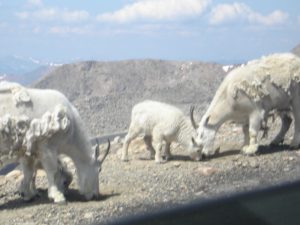
Two old goats having a snack with a kid on Mount Evans.
- Spending time with grandchildren is a retirement bonus. If you don’t have any, rent some. Their fresh views on life and general cuteness will bring you joy.
- Your income may be down just when you are free to have fun. Check into national park passes for seniors, outdoor concerts, art shows, speakers sponsored by colleges or libraries.
- Medical issues, yours or your spouse’s, can suck up a lot of time. Take care of your health (viva la colonoscopy!) but don’t obsess over it.
- Your house may seem messier. Well, maybe it really is messier but, again, don’t obsess over it. Remember, those dust bunnies need a place to live, too.
- Hang out with people who think young, like my 95-year-old friend who waved off my question with this comment: “Retirement? It’s not for me. ”
- Remember, Moses was 80 years old when he was called to lead the Israelites out of Egypt. As long as you are here on earth, God has a plan and a purpose for you.
- Relish the view from here, because you’ve earned it.

Those who are planted in the house of the Lord shall flourish in the courts of our God. They shall still bear fruit in old age; They shall be fresh and flourishing, to declare that the Lord is upright.” Psalm 9: 13-14
Freedom without Chaos
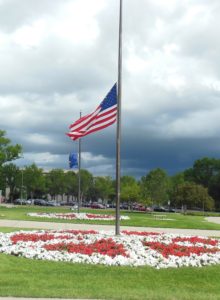
The United States flag is at half-mast. Again. Always an unsettling sight, the lowered flag is a signal of national mourning, a telling sign of national turmoil.
This is a mind-scorching summer for Americans. If you’re like me, you wonder how to react to the trouble that surrounds us. Shall we pack a pistol, just in case? Hunker down in fear? Rage against others? Or just ignore the headlines?
Ironically, the summer of 2016 resembles 1968 for its trouble on all sides, including violence, demonstrations, and a contentious presidential race. And I’m not alone in seeing the similarities. This past week, syndicated columnist Ross Douthat contrasted the “sticky summer of 2016” with the “maelstrom of the late ‘60s and the ‘70s” in a column entitled, “Are we as a country unraveling?’
Are we unraveling? If we are, then it’s time to consider who we are, where we are headed and what we believe.
Related to the fractious ‘60s and ‘70s, Francis A. Schaeffer addressed similar questions in his 1976 book How Should We Then Live? The Rise and Decline of Western Thought and Culture. The book was later the basis for a series of 10 films narrated by him.
Schaeffer was one of the great thinkers of the 20th century. After a lifetime of learning theology, philosophy, sociology and the arts, he came to a simple conclusion: What we believe will guide how we act as individuals and as a nation.
Schaeffer believed that a society based on biblical laws would have “freedom without chaos.” Indeed, our Constitution is based on Judeo-Christian beliefs. I’ve always wondered what do people have against God’s laws? Don’t murder. Don’t steal. Honor your parents. Don’t mess around with your neighbor’s wife. How many people can actually even name the 10 commandments? (Found in Exodus 20.)

The Mayflower Compact
Laws based on biblical beliefs give us a framework for conducting our lives and provide a road map for governing. If our nation is coming apart at the seams, perhaps it’s time to return to the original foundation. As someone commented recently, if everyone followed the same laws, we wouldn’t need many law officers. Or court systems. Or jails and prisons.
The Bible begins with Old Testament stories about Adam, Abraham, Moses, Joshua, Debra, Esther and others. It tells the raw truth of human frailties and victories (best read in a modern language version.) It’s noteworthy that God often told his people to be strong and have courage. He wants us to be leaders and not fall apart in the face of difficulty. He’s given us the keys to do that.
In the New Testament, those keys were given to some fishermen, a government hack, a prostitute and others. Through the power of God, they brought hope to the whole known world.
No one in the Bible offered more insight into an overcoming life than Jesus, who warned of wars and rumors of wars, but also said not to let our hearts be troubled.
In the face of today’s troubles, we may feel weak and helpless, but cheer up! While God’s laws never change, neither does his grace. If we will only seek him, as individuals and as a nation, he will give us the favor and power we need to make the world a better place for ourselves, our children and for generations to come.
Along with the Bible, there are numerous Christian authors who offer hope for the times we live in. Here are a few:

North Dakota State Capitol
- Living with Confidence in a Chaotic World by Dr. David Jeremiah
- Traveling Light by Max Lucado
- Awakening America: Through the Gates of Moral Decency by Kari Bitz
- For a look at what is right about America, see 240 Reasons to Celebrate America Right Now in the July issue of Time magazine. No. 86 is “A government Jefferson could love” which shows a photo of the North Dakota capitol and praises our state legislature where “every bill gets a vote.”
“I have told you these things, so that in me you may have peace. In this world you will have trouble. But take heart! I have overcome the world.” Words of Jesus in John 16: 33
This month the Prairie Lighthouse is one year old! Thank you readers!
Favor and Grace
We were driving home after a trip out west. At dusk, we stopped in a Wyoming town and asked a gas station attendant about a good place to stay. She said her friend owned a nice motel just a couple blocks away. Beyond tired, we took her advice and stopped there for the night.
What she hadn’t told us was the little motel sat a stone’s throw from a railroad track and coal trains rumbled past about every fifteen minutes. The whole room juddered so badly that the dust fell from the curtains like snowflakes and the lone picture rattled against the wall. We hardly got any sleep. 
The next morning, we left and drove over a hill not a mile away. And there, there in the early morning sunlight, sat a mirage: A lovely hotel/convention center with an iridescent fountain in the front acreage. Swans floated gracefully on a lake. Flowers grew profusely.
For an instant, we thought maybe one of those trains had gone off the track, we had died and were rolling into heaven. But no, we were in still in Wyoming. We stopped to eat breakfast in this beautiful setting. It turned out that a room at the nice place cost about the same as at the Shake & Rattle Motel.
So often we settle for less, when something so much better is within reach.
Finding and living in the favor of God is one of those things we can miss entirely and never know it, just as we missed the nice place to stay because we didn’t believe we had a better choice.
But what exactly is favor? There are many definitions, some nouns and some verbs. One of my favorites is “gracious kindness.”
Recently, my sister-in-law, Dee Dee, served as a very human example of gracious kindness. She wants the very best for her granddaughter, so when the little girl celebrated her fifth birthday, Grandma bought dozens of delightful gifts for her. She stayed up late wrapping presents and could hardly wait for her granddaughter to open them.
Dee Dee enjoys giving good gifts, she has the means to give them and she loves her granddaughter enough to want the best for her. All her granddaughter has to do is open the gifts. She doesn’t have to earn them, they are hers because she’s part of the family.
The same can be said of God. He enjoys giving his children good gifts, he has the means to do it, and he wants the very best for us. Our part is to receive his gifts. Jesus himself said, “If you, then, though you are evil, know how to give good gifts to your children, how much more will your Father in heaven give good gifts to those who ask Him?”
What gifts does he have for us? Wow! The list is long, but it starts with the gift of eternal life, made possible through great sacrifice. How about peace of mind? Joy in the midst of trials? Healing for our hearts and bodies? Favor with God and humankind?
When my husband and I were newbie Christians a long time ago, we heard a speaker named Bob Buess, who talked enthusiastically about the favor of God. He said, “Your success and favor do not depend on your intelligence or ignorance, or your strength or weakness. Rather, they depend on your absolute conviction that your victory is in Jesus Christ and not in yourself.”
Too often, I forge ahead on my own and end up in an unpleasant place, rather than seeking out the help and blessing of my heavenly Father. But that doesn’t mean that he isn’t there, beckoning me to his knee, ready to favor me with love and kindness. Ready to favor you, too, because he is “able to do immeasurably more than all we ask or imagine, according to his power that is at work within us.”
News About the Prairie Lighthouse Blog
 The Prairie Lighthouse Blog is celebrating its first anniversary this month! Thank you, faithful readers. You inspire and encourage me.
Beginning this month, the Prairie Lighthouse Blog will feature a new series. It’s part of a study I’m developing with the working title of “Finding the Favor and Calling of God.” Lately, the words “call of God” or “God’s Calling” seem to leap out of every book or scripture I read. It’s like I’m being led into a deeper understanding of something that is so important to all of our lives. Something that is as vast as the prairie.
One could spend a lifetime discovering more about the soil, rocks, potholes, creeks, lakes, rivers, grasses, wild flowers, trees, birds and animals that make up the prairie.
It’s the same way with this inspiring topic. I have much to learn about favor, grace and God’s calling. I hope to share some of what I discover with you.
As always, your comments and questions will be appreciated.
Family History at the Heart of Muir Guest House

The Muir Guest House
One hundred years ago today if you’d knocked on the door of what is now the Muir Guest House in LaMoure, N.D., Bessie Muir would have opened the door and welcomed you into the front porch.
She might have been holding baby June, while little Donald, 4, played nearby. Neva, 7, and Margaret, 6, would have been in school, while her husband, Gale, was off doing carpentry. You might have spied her sewing machine near a window, with a piece of fabric still under the needle. In the kitchen, perhaps bread baked in the old-fashioned oven.
Last year, Bessie and Gale’s granddaughter and her husband, Nick and Judy Muir Meisch, purchased the property. Since then, Judy has invested much thought and energy in providing an attractive, comfortable place to stay for people visiting LaMoure.
We cousins share an enthusiasm for the Muir family history. Interest increased about 10 years ago, when Bessie and Gale’s son Wallace Muir (1921-2008) published The Muir-Kloubec Genealogy and History 1708-2005 and I was lucky enough to help him with the editing after he spent 20 years doing the research and writing.
My heart was captured by the story of Bessie’s early years. She grew up with one family crisis after another, so how did she remain unaffected and become a woman of kindness, humor and hardiness? How did she overcome the painful secrets she locked away in her heart? Based on Uncle Wallace’s research, I spent seven years writing Bessie’s coming of age story. One of these days I hope to announce that it has been published. Meanwhile, there’s the Muir Guest House story.
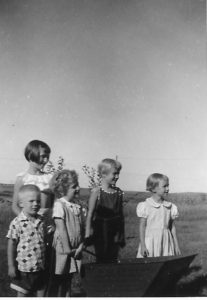
Some of the Muir cousins playing at Grandma’s house.
A few years ago Judy also purchased another house owned by Bessie and Gale. One they lived in for decades, located two doors west of the Muir Guest House. This is the house where we cousins remember enjoying many happy family gatherings. Bessie and Gale moved there in 1919 because they were outgrowing their “tiny” house. Ironically, this house isn’t much bigger than the other, but they managed to raise eight kids there.
I’m proud of our family history, not because anyone was rich, famous or powerful (although there is that longshot connection to the Muir Castle in Scotland), but because they were people of hope, faith and integrity. The kind of people who make America a good place to live.
Congratulations Judy and Nick on the opening of the Muir Guest House. See more photos at www.Facebook.com/Muirguesthouse. Photos of the house are courtesy of Leah Meisch Photography.
Here is one of my all-time favorite quotes: “Every life is the result of series of choices and crossroads—not only ours, but those of our ancestors for generations behind us. In the present, as in the past, each individual holds a key to the future. We stand at the crossroads of our personal histories and the decisions we make set into motion values and attitudes that affect not only our own development as men and women made in the image of God, but the choices and decisions that will face our descendants for generations to come.” Michael Phillips and Judith Pella in The Stonewyke Legacy.
Newbie author reviews the year
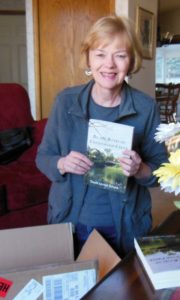 When I was about six, I tried to cross Cottonwood Creek by leaping from stone to stone. I made it to the other side, but my shoes and anklets were wet. That’s how I feel about the last year as I’ve gotten my feet wet as a published author.
Yes, a year ago this month, the UPS guy rang the doorbell and left two boxes of books on our steps. The first copies of By the Banks of Cottonwood Creek had arrived…a week early. I’ve been trying to catch up ever since!
My first book signing was arranged for just two days later. The following Sunday, I signed books at a craft show in Braddock, N.D., (pop. 21). By the time we arrived home, a stranger had left a phone message saying she’d purchased the book. She was enjoying reading it and wanted to know if I had other books out.
That got to be a theme. People who liked the book at all, really loved it. They read it fast and wanted a sequel right away. Could I write another book?
But I was already marketing “Cottonwood Creek” and writing a historical novel. Wasn’t that enough? I had over eight years and my heart invested in my historical novel, so I began working extra hard on it. Then one euphoric day last June, after a marathon writing session, it was finished. Oh my beloved historical novel, may you find a publisher soon!
Meanwhile, I started writing the sequel to “Cottonwood Creek” and am really into it. In fact, I’ve received a few odd looks this year when I talk about the characters as if they are real people. They are to me! They live in my head making decisions, talking to each other, proposing marriage…
 Leaping among the creek-washed stones this year, I’ve learned a lot. Chiefly, that it is God who helps me show life on the prairie and how people can live, love and work with Him at the center of their lives.
In a recent rerun of the British sitcom Downton Abbey, the cook, Mrs. Patmore, was going blind. She was afraid to admit it, because as she put it, “What use is a blind cook?” When she was brought into the presence of her employer, Lord Grantham, she expected to be fired. Instead, he arranged for her to have eye surgery in London, so she could continue as a valued part of the household.
That’s how I feel. I have so many shortcomings and blind spots, but the Lord brings me into His presence and lets me know I’m valued. There are so many scriptures that encourage me, but none more than in the book of Philippians. Consider these words:
“Being confident of this very thing, that He who has begun a good work in you will complete it…” Phil. 1: 6
“I press toward the goal for the prize of the upward call of God in Christ Jesus.” Phil. 3: 14
“I can do all things through Christ who strengthens me.” Phil. 4: 13
The outpouring of good will from friends and readers also inspires me. Thank you for your kind words, giving editorial feedback, and encouraging me when my doubts and fears creep in. Thank you for purchasing books, providing publicity, stocking the book in your shops, and hosting book signings or readings.
Among my chief supporters are people who pray for me daily. I feel the power of those prayers! I’m especially grateful to Larry, who agreeably waded into this Cottonwood Creek adventure with me. Thank you and God bless you every one.
You can sign up for the monthly Prairie Lighthouse blog posts and read past posts at www.gaylelarsonschuck.com.
Forgiven, Set Free, Renewed by Grace
 Happy Easter! Do you have a favorite Easter memory?
One of mine is of sharing Easter breakfast with the members of the Youth Fellowship group when I was a teen. We met at the parsonage. Think about that a minute. It’s Easter, a busy day for pastors, and our pastor and his wife had five kids. Still, they graciously invited a bunch of teens over for Easter breakfast. I might add that some of us were dressed in our finest patent leather 1-inch pumps and some of the boys were pretty rowdy (you know who you are.)
One year, I volunteered to bring Easter Lilies, a delicacy created by my mother by baking individual sponge cakes one at a time on oven-proof saucers. This treat was just made at Easter and she usually sent small boxes of them to my sisters who couldn’t come home for the holiday.
When I told Mom I had volunteered her to make x amount for the breakfast, she had to sit down for a minute and recover from the shock, but she dutifully baked enough for the whole group. (She didn’t trust me to do the baking, but I got to help frost them and put the orange slice in.) I’m so pleased that a number of my nieces carry on the tradition of making Easter Lilies. The photo is of me holding a plate of Easter Lilies back in 1997.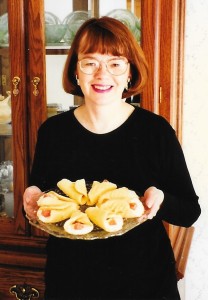
This Prairie Girl is really into Easter traditions. I love Palm Sunday. On that day long ago, people were praising Jesus. The Bible says if they wouldn’t have praised Him, the very rocks would have cried out. This year on Palm Sunday our children’s pastor and a bevy of kids belted out a song that had the whole congregation standing to its feet ready to cheer, like on the original Palm Sunday.
I also read through a gospel account of the passion and resurrection of Christ. Reading about the betrayal, mock trial and death of Jesus is hard, but the bitterness of that story makes the resurrection so much more wonderful. It shows us that there is hope even in our darkest hours, when we think all is lost.
The tradition I like best is attending church on Easter morning. The earlier the better. There is an eagerness to the service, as though Jesus has just risen from the grave and we, his disciples, are coming to celebrate. I always hope we sing Christ the Lord Is Risen Today, which Charles Wesley first published in 1739. The music and words are so powerful that almost three hundred years later, I can’t sing it without being choked up.
The message of Easter is multifaceted, but it can be boiled down to this one word: Hope. Jesus Christ brings new hope for each of us. On Easter, we pause to honor our Lord because we are forgiven, set free, and renewed by grace.
So, dear readers, may you find fresh joy in the Easter message this year and don’t forget to sprinkle the holiday with some tradition. Dye eggs on Good Friday. Have some raisin sauce with your Easter dinner. If you want to make Easter Lilies, send me a message and I’ll forward the recipe.
Hebrews 10: 23 states, “Let us hold unswervingly to the hope we profess for he who promised is faithful.”
I’ve been working on the manuscript for the sequel to “By the Banks of Cottonwood Creek.” Several chapters relate to Easter. To see the preview of the chapter entitled The Holy Thursday Pizza Party, check out my website at www.gaylelarsonschuck.com.
The Friendship Ring
 Back in the day before mood rings, promise rings, and nose rings, there were friendship rings. These silver bands were popular with the junior high crowd and girls gave them to each other for birthday or Christmas gifts.
While most of my friends proudly wore friendship rings, I felt bad because no one had given me one. Then on my 14th birthday, I received a silver friendship ring with a heart at its center and one on each side! It was one of the nicer friendship rings I’d seen.
What I didn’t want to admit was who had given it to me: my mother. How embarrassing!
Classmate: Nice friendship ring! Look at those neat hearts! Who gave it to you?
Me: Mumble, mumble.
Classmate: Who?
Me: My mother.
Classmate: Oh. Gotta go now.
The irony was that Mom and I didn’t have a warm mother-daughter relationship. How I wished for “heart to heart” talks with Mom, as Sandra Dee and Annette Funicello had with their mothers in the movies, but Mom was closed to such nonsense. Instead, as I grew up she became the army sergeant, while I donned a black jacket and boots and took to smoking Winstons.
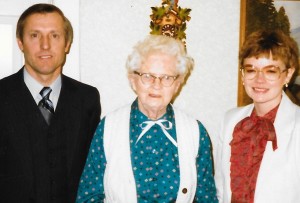
Larry, Mom and me in 1985
After I married and had a family, we got along better. We’d visit her on weekends and spend holidays together. When it became harder for our family to get away, Mom seemed to understand. She worked until she was 73, traveled, made quilts, and did the one thing she said she’d never do–have coffee klatches with friends.
Mom died thirty years ago this week. Since then, much too late, I have gained more understanding of my mother. The hardships she and Dad faced as they raised my siblings during the Depression. The dreams that blew away during the Dirty Thirties. Raising a late baby (me) while my father’s health failed. Perhaps most difficult, the hope she must have lost for the future.
Mom never said, “You did a good job,” “I love you” or “follow your dreams.” Instead, Mom did her best for me, by making complete wardrobes for my dolls, in providing money for milk at school and for “bank day” savings, even when the pay check hardly covered the rent; paying for art lessons while I was in high school; and the gift of a friendship ring. None of this was done with a smile or a hug.
Today, the ring is a reminder that not everyone communicates in the same way. Sometimes we must listen with our hearts rather than our ears.
I still have the friendship ring. Its sterling silver heart has a patina now, and surprisingly, it still fits my finger. Through it, Mom seems to reach out to me across time. I’m honored to tell people it was a gift from a good friend: my mother.
But don’t just listen to God’s word. You must do what it says. Otherwise, you are only fooling yourselves.
James 1: 22 NLT
Where Every Bean is Gifted
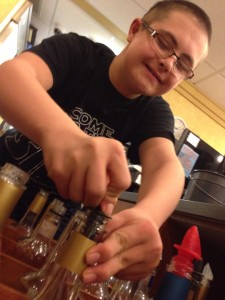
Cristian McMerty
Need a heart-warming story for a January day? Step inside the doors of The Gifted Bean Coffee House, a place overflowing with optimism, good will and, of course, great coffee. Smiles are free and so are the clever sayings that show up in the shop and on their Facebook page.
Caution: Java installation 95% complete. Installation in progress.
The shop opened in Bismarck Public Library in October 2014, serving up coffee, lunch, the best chocolate chai ever (not just my opinion). On any given day, you may find friends chatting over fresh hot sandwiches, someone engrossed in a book, a writer at work, librarians rushing in to grab a cuppa, or maybe a party of individuals with unique abilities enjoying one of the games the shop has available.
However, to fully appreciate The Gifted Bean, you need to know that a “gifted bean” is really a “being who is gifted.” This family-owned business has a larger purpose.
Matt and Sandy McMerty were a career-track couple when their first son was born 14 years ago with Down syndrome. They soon became involved in community efforts to support people with disabilities. However, they wanted Cristian to dream of a future of greater independence. They decided to find a business where he could work when he grew up to support that dream. When the shop became available, they saw it as it as “bean” their opportunity.
Coffee. Helping millions of people put on pants and say words…we are proud to help in the effort.
Their dream is becoming reality. Cristian, his parents, and siblings, all work in the shop, along with other staff, serving up great customer service. Recently, Cristian handed out his new business cards. They read, “Hello, I’m Cristian McMerty and I’m the future owner of The Gifted Bean, where every bean is special.”
The McMerty’s efforts are making a positive influence not just in Cristian’s life, but throughout the community. Their inspiring story has been shared in TV, newspaper and magazine stories. In 2015, they were named Employer of the Year by The Arc of Bismarck for their contributions to the lives of people with disabilities.
When The Gifted Bean opened in 2014, I was still with The Library Foundation, working in the Library. Each morning I stopped by for a good cup of coffee and, well maybe, one of those fresh chocolate peanut butter bars.
Coffee and friends make the perfect blend.
Now that I’m retired from the Library, I’m still a weekly customer. After By the Banks of Cottonwood Creek was published last year, I stopped by for coffee and shared the news. To my surprise, they offered to sell the book, the first store in Bismarck to make it available. Now when I walk into the shop and a barista waves an envelope at me, I know they’ve sold another copy. It makes me happy, not just because of the sale, but because it feels like they are on my team. And I am on theirs.
Writing Update: Many thanks to all who ask about the sequel to By the Banks of Cottonwood Creek. 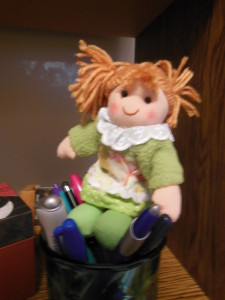 You’ve helped me keep writing through this dreary winter. Although, I must admit, the fast moving romance between Kelly and Amber does make my fingers tingle as I type away. One of the pleasures of writing is finding out how the characters deal with the situations thrown at them. Kelly and Amber are getting a lot of practice at that! Another pleasure is meeting new characters, such as this sweet, sassy rag doll, who makes her debut in the sequel. However, for now she’s content to supervise the office from her seat in my pen jar.
Thought for the Day: Let us not grow weary in doing good, for at the proper time we will reap a harvest if we do not give up. Galatians 6: 9