2015 Similar to First Christmas
 Christmas 2015 is a lot like the first Christmas: terror, political unrest, and refugees are the hallmarks of the season.
Truly, the Prince of Peace was born in troubled times, not much different than today. Rome ruled the western world with a brutal hand, causing people to live under a black cloud of fear. In Israel, people divided into political factions seeking power to change their lives.
The tension was ratcheted so high that, based on a rumor, King Herod ordered the murder of all the baby boys in Israel. A young Israeli family we know as Mary and Joseph became refugees in a foreign country to protect their little boy, Jesus.
Like today, people commonly put their hope in politics, rather than in spiritual renewal. They wanted a military messiah that would throw out the Romans. They weren’t prepared for Jesus’s message of personal repentance, hope and peace. 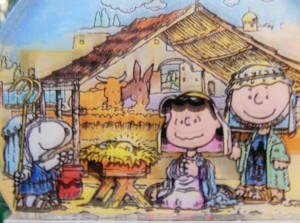
I Corinthians I: 27 states that, “God chose the foolish things of the world to confound the wise.” And really, what could be more foolish than sending the messiah to earth as a baby to be raised by a carpenter in an obscure country?
Yet, no person has had more influence across time than Jesus. He has changed hearts and fixed broken lives, and thereby has changed nations and the path of history. The good news he brought still uplifts and transforms today, as it did when he preached it on a Judean hillside.
This Christmas is a good time to focus on Christ’s message as he offers power for life today, peace amid the chaos, and hope for eternity. There will always be trouble in the world, but as he said, “Be of good cheer, for I have overcome the world.” With his help we can find peace no matter what the circumstance.
One way to do that is read his book, the Bible. Did you know there are over 3,000 promises in the Bible? For the last six months, our Sunday school class has been studying One Hundred Promises of God by Nick Harrison. Although I’ve been teaching for almost 30 years, it has helped me identify those promises more easily. Here are a couple I really like:
“Fear not for I have redeemed you; I have called you by your name; You are mine.” That’s Isaiah 43: 1.
How about Philippians 4: 19? “God shall supply all your needs according to his riches in glory by Christ Jesus.”
In addition, there are over 2,500 prophecies in the bible. Here is one pertaining to the Messiah written about 700 years before Christ and found in Isaiah 9: 6, “For to us a child is born, to us a son is given, and the government will be on his shoulders. And he will be called Wonderful Counselor, Mighty God, Everlasting Father, Prince of Peace.”
My prayer for you this holiday season is that, like the wise men of old, you will seek him, because he is still the Prince of Peace. As our pastor, Dan Kent, said recently, “No Jesus, No peace. Know Jesus, know peace.”
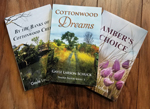
In closing, my husband, Larry, and I want to thank you for the support you’ve shown this year. Publishing “By the Banks of Cottonwood Creek” has been quite a journey and the very best part has been the encouragement you have given along the way. Merry Christmas and have a blessed New Year!
Whom Shall We Thank This Thanksgiving?
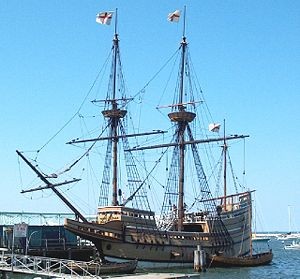 This fall we stood on the tip of Cape Cod on a wet, cold day and watched the Mayflower II bob offshore. We also peered over a railing at Plymouth Rock, where the Pilgrims first stepped ashore. The day we were there, a Northeaster was blowing hard, rocking everything, so we didn’t stay long. The day was much darker than the photo to the left!
The Pilgrims probably experienced the same type of weather as we did. They arrived at Plymouth on November 21, 1620, after spending 63 storm-tossed days in the hold of a cargo ship. There was no warm hotel room awaiting them at the end of their journey.
That first winter, about half the 102 Pilgrims died of cold, disease and starvation. But they also found Native American friends, such as the English speaking Squanto, who taught them how to survive in the new land. The next year, in November 1621, they held the first Thanksgiving feast. Their good neighbors were the honored guests at the three-day celebration.
It is popular today to take a jaded view of the Pilgrims and make fun of their shortcomings. However, it was Theodore Roosevelt who said it’s not the critic who counts, but the man in the arena. www.goodreads.com/quotes/7-it-is-not-the-critic-who-counts-not-the-man. I doubt any of the critics have come close to enduring the hardships faced by the Pilgrims, nor have they said or done much that will have a positive influence on the world.
Still, the critics are rewriting the history books, avoiding the real reasons the Pilgrims came to America. How will they ignore the Pilgrims’ objectives, which are clearly found in the Mayflower Compact, the first governing document of Plymouth Colony?
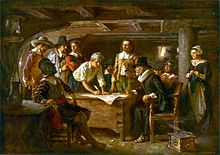 The Mayflower Compact is just four sentences long. The Pilgrims wrote it on the boat before they went ashore. Yet it has provided direction for this country for almost 400 years; The U.S. Constitution was based on the general principles found in it. Here it is:
In the name of God, Amen. We, whose names are underwritten, the loyal subjects of our dread Sovereign Lord King James, by the Grace of God, of Great Britain, France, and Ireland, King, defender of the Faith, etc.
Having undertaken, for the Glory of God, and advancements of the Christian faith and honor of our King and Country, a voyage to plant the first colony in the Northern parts of Virginia, do by these presents, solemnly and mutually, in the presence of God, and one another, covenant and combine ourselves together into a civil body politic; for our better ordering, and preservation and furtherance of the ends aforesaid; and by virtue hereof to enact, constitute, and frame, such just and equal laws, ordinances, acts, constitutions, and offices, from time to time, as shall be thought most meet and convenient for the general good of the colony; unto which we promise all due submission and obedience.
In witness whereof we have hereunto subscribed our names at Cape Cod the 11th of November, in the year of the reign of our Sovereign Lord King James, of England, France, and Ireland, the eighteenth, and of Scotland the fifty-fourth, 1620.
This Thanksgiving, we would do well to remember the beginning of our great nation. America remains a beacon of light to the rest of the world. Let’s shrug off the pride we take in our own accomplishments and humbly give God the glory for what he has accomplished through us.
There are a number of good books on the topic of Early America. The Light and the Glory by Peter Marshall and David Manuel, which was first published in 1977, is an enlightening read and is available online.
About the Korean War…
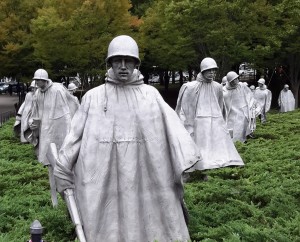 The Korean War Memorial in Washington, D.C., brings home the reality of war like none other. Dedicated in 1995, it includes 19 stainless steel statues, a mural wall, a United Nations wall and a reflecting pool.
The statues depict troops moving through a rice paddy in Korea. They are riveting during the day and downright eerie at night. The larger than life figures from the Army, Marines, Navy and Air Force are dressed in full combat gear. No matter where you stand, one of these statues is looking right at you.
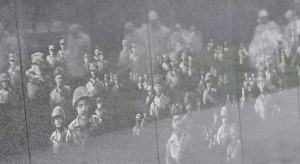
The wall is 164 feet long and has 2,500 photographic images sandblasted into it of land, sea and air troops. You can touch the photographed faces of men who fought in Korea.
 We do not talk about the Korean War very much, even though over 54,000 Americans died there. The sobering numbers of soldiers who died, were wounded or went missing in action are listed on granite blocks near the pool at the memorial.
Korea was divided during World War II. It officially became two countries in 1948. Then in 1950, China and Russia invaded South Korea. Eventually 21 countries came to South Korea’s defense and the United States provided 88 percent of the support troops. The war ended in 1953.
Since then, an intense contrast can be seen in the progress of each country. South Korea is a democracy with the 13th strongest economy in the world. Its 50 million people value education. About 30 percent of the people are Christian. The rapid rise in the standard of living and economic expansion have been dubbed the Miracle on the Han River. Think Samsung, LG and Hyundai. Per capita income in South Korea is over $28,000 per year.
North Korea has been ruled by despots since the end of the war. It has the worst human rights record in the world. Whisper something against the government and you are likely to find yourself in a harsh work camp without the benefit of a trial. The government controls every part of society. Per capita income stands at about $1,500 per year.
There is no limit to what can be done when people have the freedom and opportunity to improve life for themselves and their families. That’s what hope and a vision can do. The contrast between the two countries might be summed up by the words of Proverbs 29: 18: Without a vision, the people perish. The reverse is also true: with hope and a vision people thrive.
And that, dear friends, is why we build memorials, hold parades and give speeches honoring those who have fought for freedom for ourselves and people on distant shores. It is why Veterans Day is a big deal in America.
Hats off to Korean veterans and veterans everywhere who have made enormous sacrifices. You make our world more safe and free so that we may have hope for the future and peace in the present.
A Book, a Movie, a Trip to New England
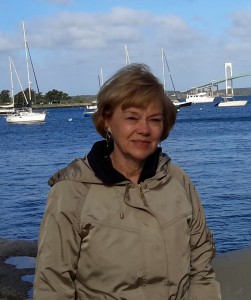 A book, a movie and a trip to New England have me thinking about liberty. We cannot, in the peaceful heartland of America, begin to grasp how the rest of the world yearns for freedom. Neither do we often get a panoramic view of the many battles that have been fought for freedom on our behalf.
In the recent Tom Hanks movie, Bridge of Spies, part of the movie is set in Germany as the Berlin Wall was being built in 1961. The scenes were grim: destroyed buildings, barbed wire, trigger-happy guards, thugs on every corner, no heat in the buildings. The people living there were totally at the mercy of an enemy (Communists) whose goal was to break them.
Those scenes fit well with a riveting book I just finished. Things We Couldn’t Say by Diet Eman, is the true story of a young woman from the Netherlands. As part of the Resistance during World War II, she helped Jewish people hide or escape. The Nazis arrested her in May 1944. Eman mused about freedom while in prison:
“One evening in August, after my hearing, a number of us were sitting and fantasizing about liberty. We talked about what it would feel like and what we would eat and where we would go.” Eman named her own freedom fantasy: “I would love to take a bath and soak and shampoo and put on clean underwear and clean clothes!”
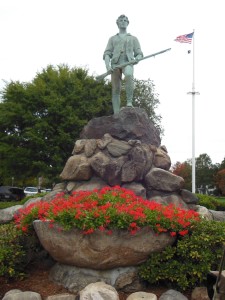
Minuteman Statue at Lexington
Ah, the simple pleasures of freedom: When was I last grateful to walk where I want, to eat bread that isn’t moldy, or have a shelf full of soap and shampoo?
Our recent tour of the New England was a trip through American history. The War for Independence becomes very real as you follow the Freedom Trail from Lexington, where the first American was killed, to Concord where the Emerson family watched from a window in their home as the Americans fired on the British for the first time. I felt the helplessness of being subject to another country; the terror of having soldiers running through the yard; and the fear as sons, husbands, and brothers enlisted.
Edmond Burke, an Englishman who lived in the 1700s, said, “Those who don’t know history are bound to repeat it.” As we traveled through New England, I was embarrassed by how much of Early American history I had forgotten.
At Arlington Cemetery in Washington, D.C., we watched the solemn changing of the guard at the Tomb of the Unknown Soldier, known but to God. Later as we left, World War II veterans were arriving. Dozens of these men passed us in wheelchairs or using canes, as the crowd applauded their courage and sacrifice.
We enjoy liberty here in the United States because these men and so many more people have fought for our freedom. Arlington Cemetery alone has over 400,000 graves, a sober testimony to the price of liberty.
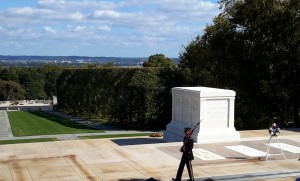
Tomb of the Unknown Soldier
“I had always taken freedom so much for granted,” Diet Eman said. “But now I knew it was a gift.”
I confess to being lackadaisical about this gift. Truthfully, I only have a surface knowledge of my rights and responsibilities as an American; I don’t sit around reading the Bill of Rights or the U.S. Constitution. Maybe I should. Maybe we all should.
You can learn more about our freedoms at: www.billofrights.org.
Dateline: New York Harbor, The Statue of Liberty
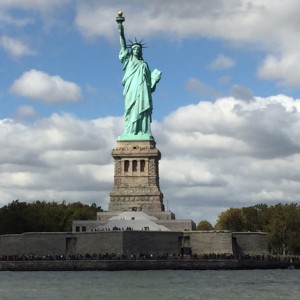
The Statue of Liberty as seen from the ferry. Photo courtesy of Deb & Doug Haefner.
Dateline: Statue of Liberty, New York Harbor. We’re on a ferry that will stop at the Statue of Liberty and then drop us off at Ellis Island. We’re on the top deck. The whole ferry is crowded, but we’ve managed to get seats on a bench in the open air. I watch as we make a wide approach to the statue and wonder what it was like for my ancestors to see America for the first time.
Behind me a man cries out, “Thee Stay-too uf Lee-bur-tee!” Over and over he says the words, making quite a ruckus over the sound of many languages being spoken all around us. “Thee Stay-too uf Lee-bur-tee!” “Thee Stay-too uf Lee-bur-tee!”
I don’t turn around to look at him, yet. I’m not sure what I’d see. Security at the Statue of Liberty remains very high because of terror threats. Is the guy behind me happy with or angry at America?
Then he climbs up to stand on the bench. His bright blue shoes all but touch my backside. “Thee Stay-too uf Lee-bur-tee! What a be-a-u-tee-foll sight!” The emotion in his voice is as deep as the harbor.
I look around to find a young dark-haired man attached to the blue shoes. A young woman and a couple children crowd near him. His face shines, his arms are thrown wide. He clearly is in love with all the statue represents.
A minute later, the ferry docks at Liberty Island. I stand up and smile at the man. “Where are you from?” I ask.
“Albania.”
What I know about Albania can be written in a few words: Centuries of war, domination by dictators, under Communism for decades.
I think of the millions of people who have endured tyranny since the Statue of Liberty was unveiled in 1886. Imagine them huddled in their dark abodes dreaming of life in the land of the freedom, the statue being their symbol of hope.
“The New Colossus” by Emma Lazarus is inscribed on the statue. Here are the words:
Not like the brazen giant of Greek fame, With conquering limbs astride from land to land; Here at our sea-washed, sunset gates shall stand A mighty woman with a torch, whose flame Is the imprisoned lightning, and her name Mother of Exiles. From her beacon-hand Glows world-wide welcome; her mild eyes command The air-bridged harbor that twin cities frame.
“Keep, ancient lands, your storied pomp!” cries she With silent lips. “Give me your tired, your poor, Your huddled masses yearning to breathe free, The wretched refuse of your teeming shore. Send these, the homeless, tempest-tost to me, I lift my lamp beside the golden door!”
Again, I wonder what my ancestors were thinking when the American coastline came into view as they journeyed to a new life. Did their hopes and dreams dare to spill out? Did they shout aloud? Did they stand on a bench and open their arms to their new country?
Compared to the man from Albania, my own patriotism is so…casually assumed. Perhaps you must live with tyranny to appreciate the freedom we so take for granted.
In coming weeks I hope to write more about the cost of our American freedom, but for this week, may the man from Albania stand as a reminder not to take our freedom for granted, but to guard it carefully.
Hidden Treasures
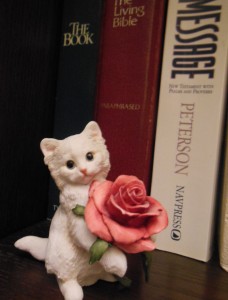 The faded red barn on our farm was the center of activity when I was growing up. Each morning and evening the cows filed into the stanchions to be milked. Bleating calves, pigs or sheep were housed on the north side. The horses had the best stall of all, right by the door. When my dad wasn’t in a rush to get the crops planted or the harvest in, he still liked to use his team of horses, Trix and Tony, for fieldwork and parades.
The second floor of the barn held the hayloft. Hay was lifted through a giant door at the front and stored for winter use. Later it was pushed out that same door into a hayrack to feed the cattle in the barnyard.
To get to the hayloft, you had to climb a set of boards nailed to the wall inside the barn. I remember working up my courage to climb that ladder for the first time, but soon I had it mastered. I loved to play all year round in the fragrant alfalfa stored in the haymow. However, spring was especially fun, because our mother cat liked to raise her kittens in the warm, quiet loft.
If I discovered the kittens before their eyes were open, I had to wait for a few days before picking them up. They were much too delicate to be handled by a little girl’s hands. However, once they were old enough to play, I’d visit them several times a day.
Finding those kittens was like finding hidden treasure. Each day I delighted in watching them grow up. First, they nestled with their mother, then they began to wobble from their cozy hollow. Before long, they were chasing the dust motes that gleamed in the sunlight streaming through a high window. Once they began pouncing on and wrestling with each other, I knew they would soon travel beyond the haymow.
For a prairie girl living on a farm with no other children nearby, the kittens were indeed hidden treasures. Finding them brought a lot of happiness to my life.
Today, I wouldn’t mind finding a nest of kittens once again, but I can count on finding another hidden treasure every day. There are many hidden gems for us in the Bible. Made up of 66 books, written by 40 authors, over 1,500 years, it contains history, adventure, prophecy, hope and encouragement.
Even when we are very familiar with the Bible, passages can leap out at us and give us new understanding to apply to our lives. The advice found there is better than any self-help book.
There are versions of the Bible for every reading preference. I personally like those with modern language, such as the New King James or The Living Bible. They are much easier to understand than texts with older language. If you haven’t read the Bible in some time, a trip through the gospel of Mark or John is a good place to start.
Colossians 3: 16 states “Let the word of Christ richly dwell within you.” That’s the New American Standard, by the way. Finding that richness is way more valuable than finding a batch of kittens and just as exciting.
Do you have a favorite version of the Bible? A favorite study guide? Tips to help others get started reading the Good Book? If you send them in, I will try to incorporate them into a blog next month. Until then, keep reading!
Here’s the Church, Here’s the Steeple
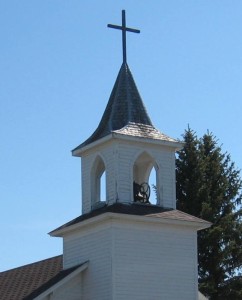 Remember this nursery rhyme? “Here’s the Church, Here’s the Steeple, Open the Doors and See all the People”?
I learned that rhyme at the simple country church down the road from the farm where I grew up. I have wonderful memories of that church. It had a sanctuary, Sunday school room and a tiny kitchen. I don’t think it even had running water, but it did have a lovely picture that hung behind the pulpit: Jesus knocking on the door.
One time, before I was old enough to read the hymnal, I was singing along with all my heart, when people around me began to chuckle. I had the words wrong. Whatever the song was, it wasn’t about a crowing rooster.
About that same time, a missionary came from India for a special Sunday afternoon service. For some reason, I was the only child present. The missionary put a tiny red bean in my hand. Inside it were three carved ivory elephants, smaller than sesame seeds. I still have that gift.
Each week in Sunday school, we learned a Bible story, did a craft and memorized a verse of scripture. One of our crafts was displayed in the church bookcase for years. I know, because I kept checking. At age 9, the church gave me my first Bible. I still have it.
The teachers, pastors and youth leaders from my growing up years cared about us kids. They knew our names. They spent time planning and teaching to help us build a strong foundation for life. I still find hope, peace and direction in the things I learned back then.
Many things have changed since my days in that little country church, but one thing remains the same: Children need a place where they are loved, encouraged and taught the truths that guide us through life. And so do we adults.
Today, 87 percent of Americans say they believe in God, but only about a quarter attend church regularly, according to a Gallup survey.
That’s too bad, because for all of its flaws, the church is still God’s hands and feet on earth. I’m blessed to attend church with a lot of ordinary people who have extraordinary stories about what God has done in their lives. They were blessed and now they bless others by teaching, counseling, praying for others, visiting those who are sick or in prison, building churches in other countries and so much more.
September 20 is Back to Church Sunday. Over 26,000 churches in 120 denominations have joined together to welcome people back to church. It’s a great day to bring your family to church or invite someone else to attend.
In Revelations 3: 20, Jesus states, “Here I am! I stand at the door and knock. If anyone hears my voice and opens the door, I will come in and eat with him, and he with me.” For many people, that relationship begins inside the church doors.
For more information on Back to Church Sunday, check out www.BackToChurch.com.
If you want to try “Here’s the Church, Here’s the Steeple,” go to www.wikihow.com/Create-a-Church-With-Your-Fingers.
“No matter what storm you face, you need to know God loves you. He has not abandoned you.” Franklin Graham
The Writer’s Group
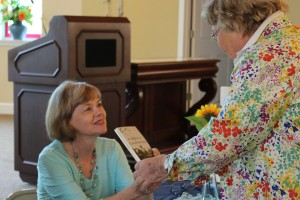
The Book Reading at Touchmark Retirement Center
For the past year, I’ve belonged to a writer’s group that meets weekly. I started because I needed unbiased eyes to read my material. Seven of us have met regularly since then. Others come and go, depending on their schedules and need for literary help.
There are many types of writer’s groups. Some are only for one genre, such as fantasy, fiction or nonfiction. Some are for just woman or just men. They may be affiliated with universities or bookstores.
Ours is none of the above. Yesterday the readings were from a couple memoirs, poetry, a western, a violent children’s fantasy, an action fantasy and some Christian fiction. Our group, Dakota Writers, was launched several years ago by OLLI, the Osher Lifelong Learning Institute. Today it runs on its own.
Our members are doctors, teachers, social workers, in public relations, in fast food, and a journalist, along with one bus driver and a cowboy. Most of them are university graduates. In the past year, at least three members have published articles or books.
While writing is solitary work, meeting with the Dakota Writers is noisy. So noisy that we depend on a bell to quiet everyone down and a timer to make sure each person has a fair share of time for reading and discussion. Sometimes, like a kindergartener, you have to raise your hand to be heard.
The group is not subtle. Unlike kindergarten, you don’t get stars for coloring poorly. No, when you’ve finished reading, everyone talks at once, launching into what is wrong with your format, and pointing out typos, redundant language or the disconnect between page one and two.
I love this group. They challenge and frustrate me at times, but I am thrilled when they have an arresting suggestion or point out a flaw I absolutely couldn’t see. My writing is better for having read it aloud to them and for their forthright evaluation.
Not that it’s easy. Reading before the group is a lot like baring your soul, because writing is so very personal. Although I’ve received my share of “constructive” criticism, one of my best moments came last fall. I had taken the first few pages of my historical novel to them. This manuscript is the essence of my life’s work, my baby, part of my soul. (Still unpublished.)
After they had ripped apart the work of a couple previous readers, I was up next. What if they tore apart my beloved first chapter? I thought about tucking the pages in my notebook and leaving. Instead, I found some gumption and began to read aloud. When I finished, there was an unusual hush in the room. It turned out they liked my story! They had minimal suggestions. My spirit soared.
Recently, I was thrilled when several members attended my first public reading of “By the Banks of Cottonwood Creek.” I joined the writers group because I needed unbiased eyes to read my work. Since then the members of Dakota Writers have become friends as well.
For information on starting a writer’s group, check out the Writer’s Digest website at www.writersdigest.com.
Quote of the day: “I guide you in the way of wisdom and lead you along straight paths.” Proverbs 4: 11
Living the Dream
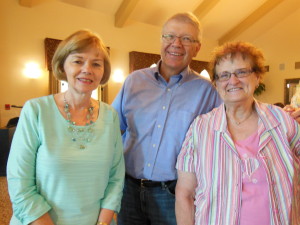
Dr. Walter and Carolyn Frank attended the Book Read
My “publicity tour” may have peaked last week. A radio interview, book reading and book signing were enough glamour for this prairie chick. New York television appearances will have to wait.
At one point, I lounged on a kitchen stool and listened to my radio interview being rebroadcast on KNDR, complete with book giveaway. I said to my husband, “Wow! We’re living the dream!” That was Wednesday.
Those summit moments are rare and must be treasured. Reality lives between them. The evening before the radio interview, when I planned to prepare for it, I instead became a Refrigerator Repair Assistant. An ominous drip had developed in the fridge, so my handy husband pushed it to the middle of the kitchen and cleaned the coils with the vacuum. My job was to turn the vacuum on and off, on and off. It took the better part of the evening.
Thursday I was back in the dream. I did a Book Read at Touchmark Retirement Center. I read a few portions of By the Banks of Cottonwood Creek. (Since it was a hot day, I read part of the snowstorm chapter.) The audience asked questions and I signed some copies of the book. It was a feel-good moment in time: A lovely setting in the chapel. A respectable audience of readers and writers from the community, as well as Touchmark residents. I hugged that moment for the rest of the week as I continued to “live the dream.”
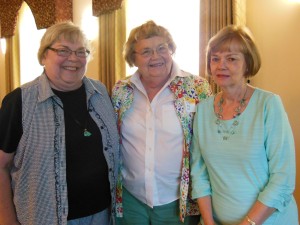
Marvia Boettcher and Betty Mills at the Book Read.
It’s not all glamour, I told myself as I drove to K-Mart in 98-degree heat on Friday. I needed a couple bags of Tootsie Rolls for a book signing at Huntington Books in Mandan on Saturday.
I had no idea how unglamourous it would get. The plan was to be in front of the bookstore under a canopy for a couple hours. The Wild West Rib Fest would be in full swing just up the street. With throngs of people moving up and down the sidewalk, I even wondered if I should bring an extra supply of books.
It was hot on Saturday. So hot the chefs at the grill fest probably turned off their grills and let the meat sizzle in the sun. The temperature hovered at 105 degrees for hours. The book signing was moved into the tiny air-conditioned shop entry so I wouldn’t melt like a deserted ice cream cone. Traffic disappeared. People were probably sprawled in the lowest (coolest) level of their houses remembering how a few months earlier they’d yearned for summer. The dream fizzled instead of sizzled.
In wrapping up this post, a couple things happened: I had first included a Will Rogers quote: “Why not go out on a limb? That’s where all the best fruit is.” Last evening I decided to delete it, shut down the computer and went downstairs to read my devotional for the day. Then a very strange thing happened. The reading for the day was headlined “Risk your life and get more than you ever dreamed,” a paraphrase of Luke 19: 26 in The Message. A few lines down was a challenge: “If you want ‘more than you ever dreamed,’ you’ve got to go out on a limb. That’s where the best fruit is.”
What are the chances of coming across that same quote on the same day?
The second irony happened this morning. As regular readers know, I get my morning attitude adjustment from the comic page of the Bismarck Tribune. This morning the Zits teenage character is “living the dream”! He finally got a job, at a supermarket. He is hoping to be promoted to smashing melons into a dumpster. Ah, we each have our own dreams, don’t we?
I can’t help but feel there are readers out there who need to begin living their dreams, whether it be writing the great American novel or smashing melons. So, dear readers, is there a dream burning in your heart? If so, why not seek the Lord’s direction and then begin the journey?
To hear the radio interview, go to http://kndr.fm/program/interview. Check out the community activities at Touchmark at www.touchmarkbismarck.com. In addition, you can find Huntington Books at Facebook.com/HuntingtonBooks, or better yet, stop in at this “novel” book shop on Main Street in Mandan.
Writing update:
The sequel to By the Banks of Cottonwood Creek is now underway. To devote more time to the book, Prairie Lighthouse posts will become less regular. However, I have a lot more topics in mind, so be sure to sign up on the website, www.gaylelarsonschuck.com, so you receive the blog post alerts by email.
Next: Microphone Jitters
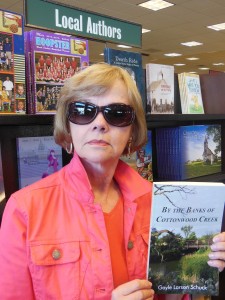 A few weeks ago, I had the jitters when my book, “By the Banks of Cottonwood Creek,” became available in my hometown. Here is the update: friends and family in LaMoure have been very gracious! Thank you.
I’m especially grateful, because of a bad experience I once caused by dishing out criticism to an author. I had read a new book called, “What I’m Going to Do, I Think” by Larry Woiwode, a former North Dakotan. Young and brash, I wrote a letter to him saying I didn’t like his book.
Months later, on Memorial Day to be exact, the phone rang at 5 a.m. Now, my father had just undergone cancer surgery and he wasn’t doing so well. Certainly, the phone jangling in the predawn could only mean my brother was calling with bad news.
Instead, the voice on the other end said, “Hi, I’m Larry Woiwode and I want to know why you don’t like my book.”
It took me a full minute to figure out the call wasn’t about my father, but about a cheeky letter I had written months before. The next 45 minutes were rather awkward. I tried to articulate (at 5 a.m., wearing my jammies) what I didn’t like about the book and scrambled to remember parts that were really good!
Years later, Woiwode told me more about his side of the phone call. He’d been away working on his upcoming novel, Beyond the Bedroom Wall, and got back to New York in the middle of the night. He stayed up reading What I’m Going to Do, I Think fan mail, hoping to hear from someone in his home state. I was the first person to write from North Dakota.
My critical words were a real downer for him. Imagine that. He’d won the William Faulkner award for that book. He wrote for the New Yorker and other big-name publications, and hung out with famous people like Robert De Niro, but what I wrote still mattered to him.
That lesson still stings. Our words are powerful, whether we’re talking with our family or a famous author. For me, learning to speak kindly and keep some opinions to myself is a lifelong process. I don’t always get it right, but hope to live by Colossians 4: 6, which states, “Let your conversation be gracious and attractive so that you will have the right response for everyone.”
Larry Woiwode is a giant in American literature and he is honored in North Dakota as the state’s Poet Laureate and a recipient of the North Dakota Roughrider Award. I fell in love with Beyond the Bedroom Wall on the first page and it is still among my favorite books.
Now that the hometown jitters are calmed, I have microphone jitters. My first book reading will be at the Touchmark Retirement Center next week. This neat place is just a few blocks from our home and I exercise there. They usually see this prairie chick sweating in the fitness center, so maybe watching me sweat in front of a microphone will be a step up.
Here is a great quote to live by: “Sandwich every bit of criticism between two layers of praise.” Mary Kay Ash